
Cherokee County Civil Docket Searches
Open the Kansas District Court Public Access Portal, accept its terms, and choose District. Search by Case Number, Party Name, Business Name, or Party As Business Name. Select Cherokee County, then use Civil, Family, or Probate or Mental Health as the matter requires. Optional file-date fields help narrow a common name.
For missing public material, use the courthouse public computer or contact the District Court Clerk at 620-429-3880. The counter is on the second floor at 110 W Maple Street in Columbus and is generally open weekdays from 8:00 a.m. to 4:00 p.m. A mailed request should identify the case number, document title, and filed date.
- Choose District and accept the portal terms.
- Enter the exact case number or focused party or business name.
- Select Cherokee and the right civil case group.
- Compare the filing date, parties, status, and newest events.
- Use the clerk or kiosk for a missing public document.
Cherokee Civil Portal Categories
The case-type choice is more than a convenience. Regular civil actions and limited actions fit the Civil filter, while domestic cases may be grouped under Family and estate matters under Probate or Mental Health. A search limited to Civil can therefore miss the right Cherokee County file.
| Clue | Portal choice | Typical code |
|---|---|---|
| Regular action | Civil | CV |
| Limited action | Civil | LM |
| Small claim | Civil | SM |
| Domestic matter | Family | Portal label controls |
| Estate matter | Probate or Mental Health | Portal label controls |
Use the filed classification instead of guessing from the dispute. Reset the form before moving to a different category.
Civil Dockets: What They Show
A Cherokee County civil docket begins with a case header and chronological event list. It may show a petition, summons, service return, answer, counterclaim, motion, scheduling order, hearing, judgment, satisfaction, or appeal reference. An event label is an index entry, not the full paper. Read a public order when the exact result matters.
| Case Number | CK-20XX-CV-000000 or another civil code |
|---|---|
| Parties | Plaintiff, defendant, petitioner, respondent, or entity roles |
| Filings | Petition, answer, service, motion, and order entries |
| Settings | Date, type, judge, location, and reset signal when public |
| Judgment | Filed decision, dismissal, default, or later satisfaction |
Service, default, judgment, and dismissal are distinct events. A short label should be checked against later entries and the public written order before drawing a conclusion.
Cherokee Civil Filing Numbers
Kansas Courts counted 930 Cherokee County civil filings in FY2024, compared with 799 in FY2023. The newer total included 77 regular actions, 613 limited actions, and a domestic-relations group of 240. Regular actions included contract, real-property, tort, and other matters.
These are filing counts, not pending caseload or outcome totals. The large limited-action category helps explain why an exact number and file-date filter can be more useful than a broad party-name search.
The year-to-year comparison also needs care. FY2023 showed 89 regular actions, 471 limited actions, and 239 in the domestic group. A rise in filings does not show that the same number remained open, reached judgment, or required trial. Each docket must be read on its own dates and entries. Annual tables are useful context for choosing narrow portal filters, not substitutes for the case chronology.
Within FY2024 regular actions, the reviewed row reported 11 contract matters, 29 real-property matters, 17 tort matters, and 20 other regular actions. Those categories describe how filings were counted. They do not state which side prevailed or what relief was ordered.
What Cases Fill the Civil Docket
Cherokee County civil court dockets cover several procedural groups. The category affects the number code, portal filter, event sequence, and public-document limits. A limited action is a court category, not a finding that the dispute lacks importance. Small claims use their own statutory framework under K.S.A. 61-2703.
- Regular contract, tort, real-property, and other civil actions
- Limited actions recorded with the LM code
- Small claims recorded with the SM code
- Family and domestic-relations matters
- Probate and mental-health matters
Family, protection, probate, and mental-health records may expose fewer details online. Use the public shell and clerk-approved redacted material instead of assuming the entire file is open.
Cherokee Civil Event Vocabulary
Civil docket terms describe steps, not merits.
- Service
- Delivery of a paper through the required method.
- Default
- A procedural result tied to a failure to respond; the judgment controls.
- Judgment
- The court's enforceable written decision.
- Satisfaction
- An entry concerning fulfillment of a judgment.
- Dismissal
- Termination whose reason and effect require the filed order.
A summons does not prove a claim. A motion is a request, not a ruling. Later entries can modify or replace an earlier event.
Hearings on the Civil Docket
A public Cherokee County case result may show a hearing date, time, event type, judge, and location. Kansas does not publish a separate Cherokee daily calendar in the reviewed sources, so find the case first. Compare the newest setting with any later order and confirm an important date with the clerk.
Eleventh Judicial District Rule 1 requires a written continuance motion at least two business days before a hearing or bench trial and at least three business days before a jury trial, except in an emergency. Filing the motion alone does not move the date. The signed and filed order controls. The full date-check sequence appears in the Cherokee County court schedule.
Missing Cherokee Civil Papers
A visible docket with no download may still lead to a public paper. Record the case number, title, and filing date, then check the courthouse kiosk. Pre-Odyssey converted documents may not appear on the internet. The kiosk provides broader public access but does not override a seal or restriction.
Ask the District Court Clerk whether an ordinary, certified, or redacted copy is available. Eleventh Judicial District Rule 13 lists 25 cents per copy and $1 for certification, with a possible $12 hourly concentrated-attention charge. Do not combine that court schedule with the separate Cherokee County KORA fee schedule. The Cherokee County Sheriff FAQ supplies the district clerk's public counter details.
The assigned Kansas eFlex portal is the attorney and party filing route, not the public case-search index.
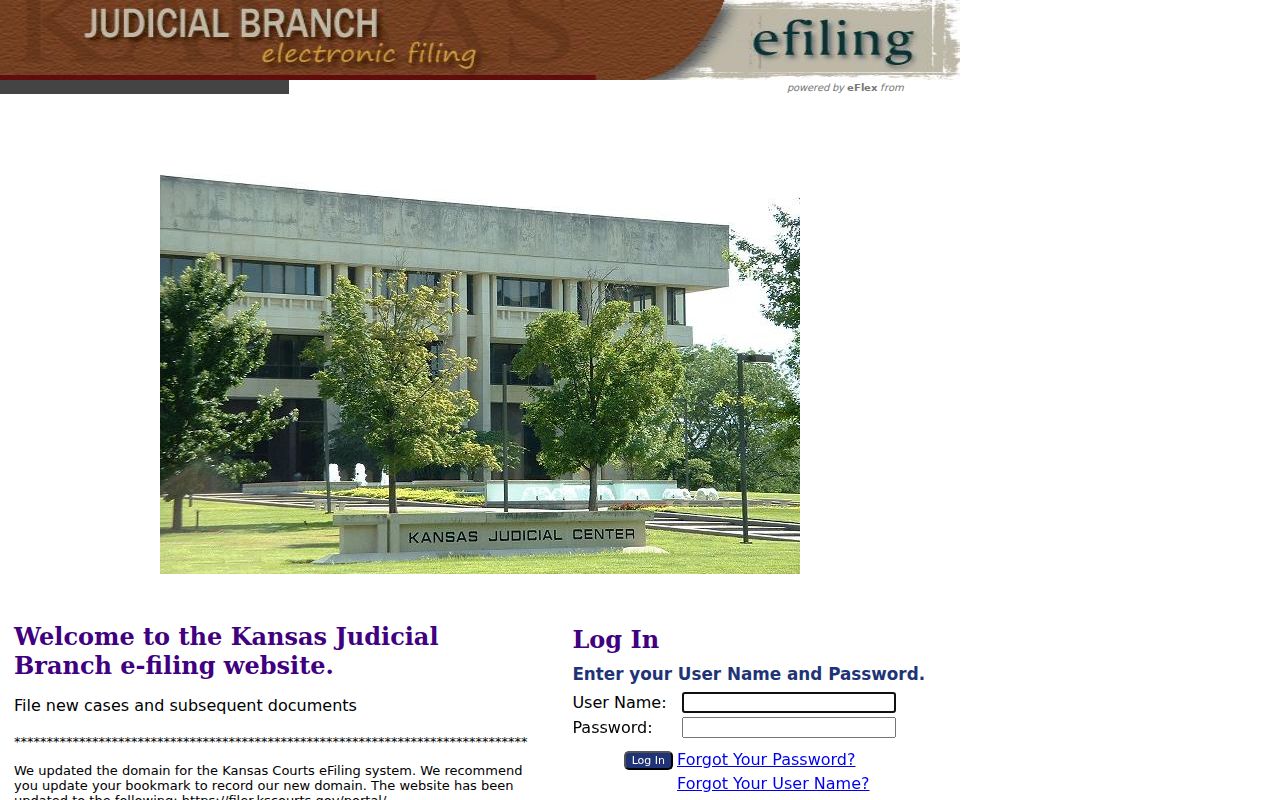
The filing-system view helps explain why submitting a paper and finding its public docket entry are separate tasks.
Older Cherokee Civil Case Access
Cherokee County moved into the Odyssey numbering environment in 2020, so an older civil paper may use a legacy number without the CK county prefix. Search the exact number first. If it fails, try the party name with a filing-year range and the most likely case group. Adding CK to an old number is not always the right fix.
Converted cases can expose docket metadata while leaving document images off the public web. The courthouse kiosk may hold the public copy, and the District Court Clerk can explain whether the gap reflects conversion, indexing, redaction, or a legal restriction. The absence of a download is not proof that the filing never existed.
Legacy search: Try the number as printed, then the alternate CK format, then a focused name-and-year search before asking the clerk.
When requesting an older judgment, state whether an ordinary or certified copy is needed. Certification authenticates the copy; it does not change the meaning of the order.
Who Can See Civil Dockets
Kansas public-record law supports inspection of nonexempt material, while Supreme Court Rules 22, 23, and 24 preserve inaccessible categories, sealed filings, and personal-information redaction. Family, protection, juvenile, guardianship, and some probate records can carry tighter limits. A public case number does not promise a complete public file.
Request the public docket shell or redacted version when available. The clerk can identify whether an item is web-unavailable, kiosk-only, pre-Odyssey, sealed, or governed by a case-specific order.
Key Rules: Kansas Supreme Court Rule 22 identifies ordinarily inaccessible court records.
Rules 23 and 24 address sealed filings and redaction, while the Kansas Open Records Act does not displace court-specific restrictions.